Combination Homeopathic Remedies: A Clear, Honest Look
Several ingredients in one bottle, sold off the shelf. Here is how those products are built, and what naturopathic care in Colorado actually involves.
You are in the cold and flu aisle holding a small box. The back panel lists six ingredients you cannot pronounce, each followed by a number and a letter. That box is one of the combination homeopathic remedies stocked in drugstores in every state, and almost nobody explains what the numbers mean.
This post does two things. It covers how these products are put together and how that differs from the way a classical homeopath works. Then it looks at what naturopathic doctors are trained in, and where herbal medicine fits, since that is a separate discipline with its own rules.
!Drug Facts panel on a box of combination homeopathic remedies showing ingredient potencies
Table of Contents
What Are Combination Homeopathic Remedies?
Single Remedy Prescribing and Why It Differs
What the Label Actually Tells You
Where Homeopathy Sits in Naturopathic Training
What Naturopathic Doctors Use Day to Day
Herbal Medicine Is a Different System
Choosing Care That Fits Your Situation
What to Tell the Rest of Your Care Team
FAQs About Combination Homeopathic Remedies
<a id=”what-are”></a>
What Are Combination Homeopathic Remedies?
Combination homeopathic remedies are over the counter products that put several homeopathic ingredients into one formula, each listed at its own dilution. They are sold for a named complaint such as allergies, sinus pressure, or bruising, so you pick them off a shelf by symptom rather than having one remedy matched to you.
You will find them as pellets that dissolve under the tongue, liquids in dropper bottles, gels, sprays, and eye drops. The front of the box names the problem. The back lists the actives.
That format is the whole selling point. Someone with a blocked head at 9pm does not want to learn a therapeutic system, and a formula built to cover the usual presentations of a blocked head removes that step entirely.
Categories you will see on US shelves include:
allergy and hay fever formulas
cold, flu, and sinus formulas
arnica-based products for bruising and soreness
teething and colic formulas for infants
sleep and calming formulas
None of that tells you whether a given product did anything for the person who bought it. It tells you how the category is organized, which is what you need when you are holding two boxes and trying to work out the difference.
<a id=”single-remedy”></a>
Single Remedy Prescribing and Why It Differs
Homeopathy did not start there. Samuel Hahnemann, a German physician working in the 1790s, built the system around matching one substance to one person based on the full pattern of that person’s symptoms. Mood, timing, temperature preference, and what makes the complaint better or worse all fed the choice.
A classical homeopath takes a long intake, often an hour or more at a first visit, then selects a single remedy at a single potency and watches what follows. Change two things at once and you have lost the thread.
Combination homeopathic remedies invert that logic. Rather than one carefully matched substance, you get five or eight of the substances most often associated with the complaint, on the working assumption that one of them will land.
Practitioners who prescribe classically tend to object to this, and the objection is internally consistent. If the method depends on precise individual matching, a formula that covers eight possibilities at once has stepped outside the method it is named after.
Neither camp is being dishonest. They are answering different questions. One is asking what fits this specific person, and the other is asking what sells usefully to a wide range of people with the same head cold.
<a id=”the-label”></a>
What the Label Actually Tells You
Look for the numbers. Every active ingredient carries a potency notation such as 6X, 30C, or 200C, and those letters describe dilution ratios rather than strength in the way you read a milligram figure.
X means the substance was diluted one part in ten and shaken, repeated as many times as the number in front of the letter, so 6X has been through six of those rounds. C means one part in one hundred, repeated the same way. A 30C ingredient has been through thirty rounds of hundredfold dilution.
Higher numbers mean more dilution. In homeopathic theory that means a stronger preparation, which runs backwards from every other label in the pharmacy.
That one detail causes most of the confusion around combination homeopathic remedies. Shoppers read 200C as a bigger dose than 6X, and in ordinary pharmacology it would be far smaller.
The rest of the panel earns a read too. Pellets are usually sucrose or lactose. Liquids often carry alcohol, at percentages worth checking if you are giving something to a child or avoiding alcohol yourself. Gels and creams have their own bases and preservatives.
If lactose is a problem for you, the pellet base can be the part that bothers your stomach rather than anything listed as active.
<a id=”nd-training”></a>
Where Homeopathy Sits in Naturopathic Training
Naturopathic doctors are not homeopaths, and homeopaths are not naturopathic doctors. The two overlap in exactly one place, which is the curriculum.
A naturopathic doctor completes a four-year graduate program at an accredited naturopathic medical school, and the coursework covers basic and clinical sciences alongside a survey of therapeutic systems that includes homeopathy. Botanical medicine, clinical nutrition, physical medicine, and counseling sit in that same survey.
Exposure is not the same as practice. A graduate leaves with working familiarity across several toolkits, then builds a clinic around the ones that suit the patients who walk through the door and the way that clinician thinks.
In Colorado, naturopathic doctors are registered and regulated by the Department of Regulatory Agencies, known as DORA. Registration sets the scope of practice and the standards a practitioner is held to, which is the piece most people are really asking about when they ask about credentials.
Dr. Karrina Wallace holds a Doctorate of Naturopathic Medicine from National University of Natural Medicine and a BS in Human Nutrition Foods and Exercise from Virginia Tech. She has served on the board of the Colorado Association of Naturopathic Doctors since 2015. You can read Dr. Wallace’s full training and credentials before you book anything.
<a id=”day-to-day”></a>
What Naturopathic Doctors Use Day to Day
Ask ten naturopathic doctors what sits on their dispensary shelf and you will get ten different answers. Same degree, different clinics.
Some lean heavily on homeopathic prescribing. Others build almost everything around botanical medicine, or around nutrition and functional testing, or around physical medicine. The training surveys the options and the practitioner chooses.
Ponderosa Natural Medicine in Wheat Ridge does not dispense or prescribe homeopathic remedies. The work here runs on Custom Herbal Medicine, nutrition and lifestyle counseling, functional lab and holistic diagnostic testing, and quality nutritional supplements. Detoxifying hydrotherapy, auricular therapy, and physiotherapy for discomfort round out the toolkit.
Saying that plainly matters, since a search for combination homeopathic remedies drops a lot of people onto naturopathic clinic websites, and the reasonable assumption follows that the two are the same offering. They are not.
If homeopathic care is the thing you want, that is a legitimate thing to want, and it is worth knowing that you are looking for a different service than the one described here. If what you actually want is someone to work out why the symptom keeps returning, that is a different conversation, and it is the one this clinic is set up for.
<a id=”herbal-medicine”></a>
Herbal Medicine Is a Different System
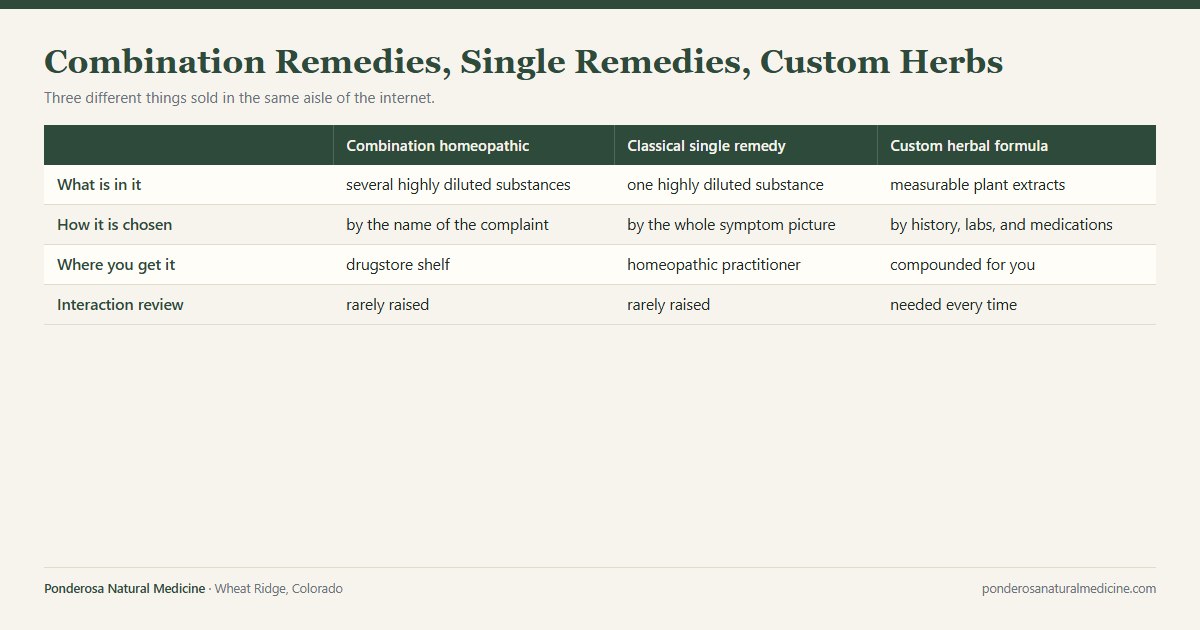
Weigh it. That is the fastest way to tell herbal medicine apart from homeopathy, since an herbal tincture or capsule contains a measurable quantity of plant material that a lab could quantify.
A custom herbal formula is built from named plants in named amounts, chosen against your history, your medications, and often your lab results. Nothing about it is diluted past the point of measurement. The plant is in there and you can taste it.
Combination homeopathic remedy
Classical single remedy
Custom herbal formula
What is in it
several highly diluted substances
one highly diluted substance
measurable plant extracts
How it is chosen
by the name of the complaint
by the whole symptom picture
by history, labs, and medications
Where you get it
drugstore shelf
homeopathic practitioner
compounded for you
Interaction review
rarely raised
rarely raised
needed every time
That last row is the practical difference. Herbs carry real interaction potential with prescription medication, and blood thinners, thyroid medication, and antidepressants are the categories that come up most often in practice. A formula strong enough to act on you can act against something else you take.
You can read the National Center for Complementary and Integrative Health overview of homeopathy and natural products for a plain-language summary, and published trials on individual herbs are searchable at PubMed.
<a id=”choosing-care”></a>
Choosing Care That Fits Your Situation
Nobody is coming for your allergy pellets. If a product on your shelf helps you get through May and it is not interacting with anything, that is your call and it stays your call.
The more useful question is a different one. If the same complaint returns every spring, or every month, or every time you eat a particular food, the useful information sits in that pattern rather than in the box on your shelf.
That is where a workup earns its keep. A first visit maps the history properly, and testing follows the questions the history raises rather than a fixed panel everyone gets. Digestive health testing and thyroid work are two common starting points when fatigue, bloating, or cycle changes keep showing up.
Combination homeopathic remedies were never designed to answer that kind of question. They were designed to address a symptom on the day you have it, off a shelf, without a practitioner in the room. Those are two genuinely different jobs, and a product doing the first one well says nothing about the second.
<a id=”care-team”></a>
What to Tell the Rest of Your Care Team
Bring the box. Whatever you are taking, the actual packaging beats trying to remember a brand name in a waiting room, and it lets any clinician read the panel for themselves.
List everything, including things you do not think of as medicine. Homeopathic products, herbal capsules, teas you drink daily, and supplements all belong on the list you hand over. Herbs matter most here, since those are the ones with a documented interaction profile.
Telling your primary care doctor about combination homeopathic remedies you use is not a confession. It is standard record keeping, and it protects you if you ever need surgery or a new prescription.
Naturopathic care is designed to sit alongside conventional medicine rather than replace it. Ponderosa serves Wheat Ridge, Denver, Aurora, Littleton, Lakewood, Arvada, Golden, Evergreen, and the surrounding Denver Metro, with telehealth available statewide in Colorado.
This article is educational and is not a substitute for individual medical advice from a qualified practitioner who knows your history.
<a id=”faqs”></a>
FAQs About Combination Homeopathic Remedies
Are combination homeopathic remedies safe?
Homeopathic products are highly diluted, so the substances listed as active are present in very small amounts. The practical safety questions usually sit with the inactive ingredients instead, such as lactose in pellets or alcohol in liquid preparations. Products for infants deserve a closer read of the panel. Talk to a clinician before giving any product to a young child.
Do naturopathic doctors prescribe combination homeopathic remedies?
Some do and many do not. Naturopathic training surveys several therapeutic systems, homeopathy among them, and each practitioner then builds a clinic around the tools they use best. Ponderosa Natural Medicine does not dispense or prescribe homeopathy. The care offered here is built on custom herbal formulation, nutrition, functional lab testing, and lifestyle work.
What is the difference between combination homeopathic remedies and herbal supplements?
Dilution. Herbal supplements contain measurable quantities of plant material that can be weighed and standardized, and homeopathic preparations are diluted in repeated steps well past that point. The two systems have different histories, different labeling rules, and very different interaction profiles with prescription medication.
Can I take combination homeopathic remedies with prescription medication?
Ask the prescriber or your pharmacist first, and bring the actual package with you. Highly diluted products raise interaction questions less often than herbs do, and that is not the same as a blanket clearance for your specific medication list. Anyone on blood thinners, thyroid medication, or psychiatric medication should check before adding anything.
Does Ponderosa Natural Medicine offer homeopathy?
No. Ponderosa offers Custom Herbal Medicine, functional lab and holistic diagnostic testing, nutrition and lifestyle counseling, lifestyle coaching, quality nutritional supplements, detoxifying hydrotherapy, auricular therapy, and physiotherapy for discomfort. Those are separate disciplines from homeopathy, with their own evidence base and their own training.
How do I know which approach is right for me?
Start with the question you actually want answered. If you want a shelf product for an occasional symptom, combination homeopathic remedies are one of several options a pharmacist can walk you through. If a symptom keeps coming back and nobody has explained why, a full naturopathic intake with appropriate testing is the better use of your money.
Book Your Visit With a Wheat Ridge Naturopathic Doctor
Straight answers beat guessing in a pharmacy aisle. A first appointment at Ponderosa Natural Medicine walks through your history, your current supplements and medications, and the testing that would actually move your case forward.
Wheat Ridge, the wider Denver Metro, or telehealth anywhere in Colorado. Book my appointment and get a plan built around your history rather than a label.
Ready to Better Understand Your Stress Response?
You do not have to keep pushing through fatigue, burnout, poor sleep, or stress-related symptoms without answers. If you are ready for a more thorough evaluation, Ponderosa Natural Medicine can help you take the next step.