What Is a Naturopathic Doctor: Clear Answers on Training
[The letters after the name only mean something once you know which school, which exam, and which state stands behind them.]
Two people can both call themselves naturopathic doctors and share almost nothing. One finished a four-year graduate medical program with supervised patient visits and national board exams. The other finished a correspondence course.
That gap is why this question keeps getting typed into search bars. What is a naturopathic doctor, in the sense that matters when you are choosing one for your family? It comes down to three things you can check before you ever book, since training, state credential, and legal scope are all matters of public record rather than marketing.
This post walks the credential from the front of the diploma to the edge of the scope.
Table of Contents
What Is a Naturopathic Doctor? The Short Answer
Inside the Four-Year Naturopathic Doctorate
ND Doctor vs an Unaccredited Naturopath
Licensing and Registration Vary State by State
What DORA Registration Means in Colorado
Scope of Practice for a Naturopathic Practitioner
What Is a Naturopathic Doctor Not Trained to Do
Reading One Doctor’s Credentials Line by Line
Questions Worth Asking Before Your First Visit
FAQs on What Is a Naturopathic Doctor
<a id=”short-answer”></a>
What Is a Naturopathic Doctor? The Short Answer
A naturopathic doctor is a graduate of a four-year, in-residence naturopathic medical program accredited by the Council on Naturopathic Medical Education. The curriculum covers the same biomedical sciences taught in conventional medical school, plus clinical nutrition, botanical medicine, and lifestyle care. Graduates sit national board exams, and in regulated states they hold a license or a registration.
That is the whole definition. Everything else is detail.
The detail matters, though, since the term “naturopath” carries no such requirement in much of the country and can be printed on a business card by someone who has never treated a patient under supervision. Knowing which one you are looking at is the single most useful thing you can learn before your first appointment.
There is a second half to the question that definitions tend to skip. What is a naturopathic doctor supposed to do differently once you are actually sitting in the room with one? The stated aim is to find what is driving a symptom, treat the person rather than the lab value, and use the least invasive tool that will do the job.
<a id=”doctorate”></a>
Inside the Four-Year Naturopathic Doctorate
The first two years look familiar to anyone who has seen a medical school syllabus. Anatomy, physiology, biochemistry, pathology, microbiology, and pharmacology are all in there, taught as graduate coursework with laboratory work attached.
Years three and four move into the clinic.
Students see patients under the supervision of licensed faculty, take histories, order and interpret labs, and build treatment plans that get reviewed before anything reaches the patient. Alongside that clinical rotation sits the material that makes the degree naturopathic rather than conventional, which includes clinical nutrition, botanical medicine, physical medicine, counseling, and hydrotherapy.
Board exams bracket the whole thing. The Naturopathic Physicians Licensing Examinations, known as NPLEX, run in two parts. Part I covers the biomedical sciences and is normally taken after the second year. Part II covers clinical sciences and comes at the end of the program, and passing it is what regulated states require before they will issue a credential.
No accredited program is available by correspondence. Residence is the point.
<a id=”nd-vs-naturopath”></a>
ND Doctor vs an Unaccredited Naturopath
Here is where most of the public confusion lives. The words sound interchangeable and the credentials behind them are not.
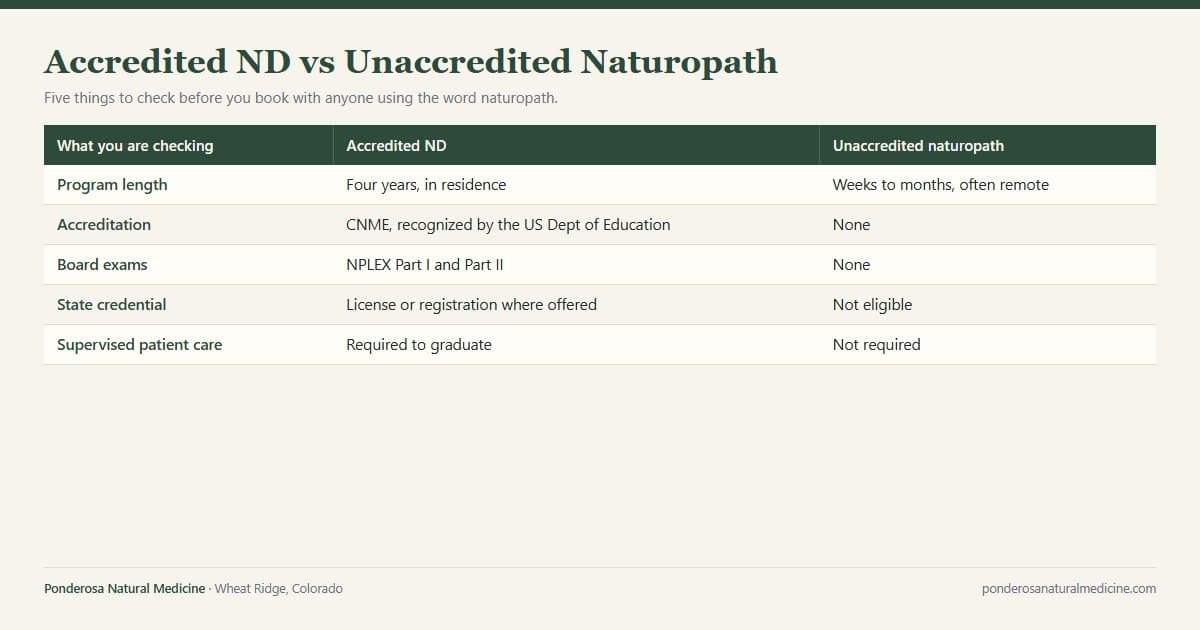
An ND doctor holds a Doctorate of Naturopathic Medicine from an accredited institution. A “traditional naturopath,” “naturopathic consultant,” or “certified naturopath” may instead hold a certificate from an unaccredited school, often earned online over a matter of weeks. That certificate does not qualify the holder to sit NPLEX or to register in a state that regulates the profession.
What you are checking
Accredited ND
Unaccredited naturopath
Program length
Four years, in residence
Weeks to months, often remote
Accreditation
CNME, recognized by the US Department of Education
None
Board exams
NPLEX Part I and Part II
None
State credential
License or registration where offered
Not eligible
Supervised patient care
Required to graduate
Not required
Neither title is illegal. In unregulated states, both are available to anyone. That is exactly why the burden of checking sits with you, and why the rest of this post is about where to look.
<a id=”state-by-state”></a>
Licensing and Registration Vary State by State
There is no national license for naturopathic medicine. Regulation is set state by state, and the differences are bigger than most patients expect when they move or switch practitioners.
Some states license naturopathic doctors as physicians with a defined scope. Others, including Colorado, operate a registration system instead. A third group has no regulation at all, which means the title is unprotected and anyone may use it regardless of where they studied.
Scope follows the credential. A naturopathic doctor practicing in one state may do things a colleague with identical training cannot do one border over, since the enabling law rather than the diploma sets the limits. Two graduates of the same class can end up with genuinely different day jobs.
For patients, the practical takeaway is short. Check your own state’s rules, not the profession’s national description.
It is worth saying out loud that the answer to what is a naturopathic doctor changes at the state line, and that surprises people who have moved. A practitioner you saw in Oregon or Arizona may work under a broader scope than a Colorado colleague with the same degree and the same board exams.
<a id=”dora”></a>
What DORA Registration Means in Colorado
Colorado regulates naturopathic doctors through the Department of Regulatory Agencies, usually shortened to DORA. Registration there is not a membership badge that a practice buys. It is a state credential tied to graduation from an accredited naturopathic medical program and to passing the national board exams.
DORA holds the register, and the register is public.
You can look up a name and see whether the person in front of you actually holds the credential they advertise, along with any disciplinary history attached to it. That single search settles the question of what is a naturopathic doctor faster than any about page, since it separates the people the state has vetted from the people using a similar word.
Registration brings the practitioner under state oversight as well. Complaints have somewhere to go. Standards have someone enforcing them. Where a practitioner is unregistered and unregulated, neither of those is true, and a patient who has a problem has very little recourse beyond a review site.
<a id=”scope”></a>
Scope of Practice for a Naturopathic Practitioner
Scope is the answer to what will actually happen at the visit. For a registered naturopathic practitioner in Colorado, the work centers on identifying what is driving a symptom rather than on suppressing the symptom itself. First appointments run long and cover history most patients have never been asked about.
The tools sit in a fairly consistent set. At Ponderosa Natural Medicine’s naturopathic services that set includes functional lab and holistic diagnostic tests, nutrition and lifestyle counseling, custom herbal medicine, physiotherapy for discomfort, lifestyle coaching, detoxifying hydrotherapy, quality nutritional supplements, and auricular therapy.
Testing is often where the work starts. Comprehensive thyroid testing is a common example, since a standard panel and a full panel can tell noticeably different stories about the same patient.
Herbal medicine here means custom formulation, prepared for the person rather than pulled off a shelf. That is a different discipline from homeopathy, and the two get confused constantly.
<a id=”not-trained”></a>
What Is a Naturopathic Doctor Not Trained to Do
A naturopathic doctor is not an emergency provider, a surgeon, or a replacement for your primary care physician. Naturopathic care runs alongside conventional medicine rather than instead of it. Chest pain, a suspected stroke, a serious injury, or a suspected cancer diagnosis all belong in the conventional system, immediately and without a detour.
Some specific limits are worth stating plainly.
Naturopathic doctors do not perform surgery or emergency intervention
Naturopathic care does not treat cancer, and no herb should be presented as a cancer therapy
Acupuncture and chiropractic are separate professions with separate licenses
Prescribing conventional pharmaceuticals sits outside the care offered at Ponderosa Natural Medicine
Homeopathy belongs on that list too. Ponderosa Natural Medicine offers custom herbal medicine, which uses measurable quantities of plant material, and that is a different tradition from homeopathic preparation. The National Center for Complementary and Integrative Health keeps plain-language summaries of where the evidence stands across these fields, and it is a reasonable place to read before you decide.
<a id=”credentials”></a>
Reading One Doctor’s Credentials Line by Line
Abstract rules get easier with a real example. Take the credentials of Dr. Karrina Wallace at Ponderosa Natural Medicine and read them the way you would read a contract. The abstract question of what is a naturopathic doctor turns into four checkable facts.
BS in Human Nutrition, Foods and Exercise, Virginia Tech. An undergraduate science degree, at a public research university, in the subject matter the later clinical work draws on.
Doctorate of Naturopathic Medicine, National University of Natural Medicine. This is the accredited four-year piece. The named institution is an accredited naturopathic medical school, which is the difference between a doctorate and a certificate.
Registered Naturopathic Doctor in Colorado, regulated by DORA. The state credential, verifiable in a public register rather than taken on trust.
Colorado Association of Naturopathic Doctors, Board Member 2015 to present and Board Director 2023 to 2025. Professional standing among peers, sustained over a decade, which is the part a weekend certificate can never produce.
Four lines. Each one independently checkable.
<a id=”questions”></a>
Questions Worth Asking Before Your First Visit
Ask where they trained, and ask whether the school is CNME accredited. A practitioner with the credential answers that in one sentence and usually seems pleased you asked.
Then ask whether they hold a state credential, and in Colorado, whether they are registered with DORA.
Ask how they work with your existing physician, since the honest answer involves coordination rather than replacement. Ask what a first visit costs and how long it runs, as naturopathic appointments are typically far longer than a conventional office visit and are often paid out of pocket. Ask what they would refer out, which tends to be the most revealing question of the set.
A practitioner who bristles at any of these has answered you anyway.
By the time you have those five answers, what is a naturopathic doctor stops being an abstract question and becomes a specific one about a specific person. That is the version worth answering, since you are not hiring a profession. You are hiring one practitioner, on one afternoon, for one set of symptoms that belong to you.
This article is educational and is not a substitute for individual medical advice from a qualified practitioner who knows your history.
<a id=”faqs”></a>
FAQs on What Is a Naturopathic Doctor
What is a naturopathic doctor compared to a medical doctor?
Both complete four-year doctoral programs with biomedical sciences and supervised clinical training, and the scopes differ. An MD or DO trains in a hospital residency and practices with full prescribing and surgical authority. A naturopathic doctor trains in outpatient clinical care with an emphasis on nutrition, botanical medicine, and lifestyle, and works within the scope their state defines.
Is an ND doctor a real doctor?
An ND from an accredited institution holds a genuine doctoral degree and has passed national board exams. Whether they are legally recognized as a physician depends entirely on the state. Colorado uses a registration system administered by DORA rather than physician licensure, so the accurate description in Colorado is registered naturopathic doctor.
How do I check if a naturopathic practitioner is registered in Colorado?
Search the practitioner’s name in the DORA public register. The record will show whether an active registration exists and whether any disciplinary action is attached. If no record appears, the person may still be practicing lawfully as an unregistered naturopath, and they have not met the state’s registration requirements.
Does naturopathic care replace my primary care doctor?
No. Naturopathic care is designed to work alongside conventional medicine, not to replace it. Keep your primary care relationship, keep your screenings, and treat urgent or emergency symptoms through the conventional system. Most naturopathic doctors will ask about your other providers at the first visit and expect to coordinate.
Do naturopathic doctors prescribe medication?
Prescribing authority varies widely between states and is one of the biggest differences between licensure and registration models. Ponderosa Natural Medicine does not prescribe conventional pharmaceuticals. The care offered there centers on custom herbal medicine, targeted nutritional supplements, functional testing, and lifestyle change.
Book With a Registered Naturopathic Doctor in Wheat Ridge
You have now got a checklist for what is a naturopathic doctor worth booking. Accredited four-year doctorate, national board exams, a state credential you can verify, and a scope the practitioner states plainly.
Dr. Karrina Wallace meets all four, and her practice serves Wheat Ridge, Denver, Aurora, Littleton, Lakewood, Arvada, Golden, Evergreen, and the surrounding Denver Metro, with telehealth available statewide in Colorado.
Book my first appointment and bring your questions with you.
Ready to Better Understand Your Stress Response?
You do not have to keep pushing through fatigue, burnout, poor sleep, or stress-related symptoms without answers. If you are ready for a more thorough evaluation, Ponderosa Natural Medicine can help you take the next step.