Naturopathic Doctors in Colorado: Avoid an Unqualified ND
The state keeps a public register of naturopathic doctors, and most patients never think to check it.
Two practitioners can both call themselves doctors of natural medicine. One holds a four-year residential doctorate and sits on a state register. The other bought a certificate online. Nothing on either website tells you which is which, and from the outside the wording looks nearly identical.
Colorado gives you a way to tell them apart.
Naturopathic doctors in Colorado are registered with the Department of Regulatory Agencies, known as DORA, and that register is open to the public. This post walks through what registration requires, what an accredited doctorate involves, what the protected title covers, and how you check a name yourself in a couple of minutes.
Table of Contents
What Does DORA Registration Mean for a Naturopathic Doctor in Colorado?
Registration and Licensure Are Not the Same Word
What the State Asks for Before Registration
An Accredited Doctorate Against a Correspondence Credential
How to Verify a Registration Yourself
What Title Protection Does and Does Not Cover
Homeopathic Doctors in Colorado Are a Separate Question
What Any of This Changes About Your First Visit
FAQs About Naturopathic Doctors in Colorado
Book With a Registered Naturopathic Doctor
<a id=”what-dora-means”></a>
What Does DORA Registration Mean for a Naturopathic Doctor in Colorado?
DORA is the Colorado Department of Regulatory Agencies, the state body that oversees regulated professions. A naturopathic doctor in Colorado who appears on its register has submitted proof of an accredited doctoral education, passed national board examinations, and accepted a scope of practice the state defines. The listing is public, searchable, and free.
That last word does a lot of work. You don’t need to ask permission, pay anything, or take a practitioner’s word for a credential you can confirm in a browser tab. Naturopathic doctors in Colorado appear on that register by name, so the check runs in both directions. A name that isn’t there tells you something too.
Registration carries a second function that gets less attention. It creates somewhere for a complaint to land. A registered practitioner sits inside a system that can investigate, sanction, and in serious cases remove a registration, and that accountability follows the person rather than the clinic they happen to work for.
An unregistered practitioner offers you none of that. If the visit goes badly, there’s no board to write to.
<a id=”registration-vs-licensure”></a>
Registration and Licensure Are Not the Same Word
Colorado registers naturopathic doctors. Several other states license them. The two words describe different levels of state involvement, and the distinction shapes what your practitioner can and can’t do here.
Colorado’s framework is newer than most patients assume. The Naturopathic Doctors Act passed as House Bill 13-1111 in 2013 and took effect on 1 January 2014, so the registration you can look up today has been running for just over a decade.
Under a registration model, the state confirms your training, protects the professional title, sets a scope, and handles discipline. Under a full licensure model, the state usually grants a wider clinical scope on top of all that, including broader authority over prescriptions and certain procedures.
So naturopathic doctors in Colorado work within a narrower lane than colleagues in some neighboring states. They aren’t licensed to prescribe conventional pharmaceuticals. They don’t replace your primary care physician, they don’t treat cancer, and they aren’t a substitute for emergency care.
None of that is a loophole. It’s the deal the profession accepted in exchange for a state-backed standard, and a good practitioner will tell you where their lane ends before you ask.
The practical version for a patient is simple. A registered ND is a trained clinician who works on nutrition, botanical medicine, lifestyle, and lab interpretation, and who refers out when something belongs with a different provider.
<a id=”requirements”></a>
What the State Asks for Before Registration
Three things sit at the center of the requirement, and each one is checkable.
An accredited doctorate. A four-year, in-residence naturopathic medical degree from a program recognized by the accrediting body for naturopathic medical education.
National board examinations. The multi-part licensing exams that naturopathic graduates sit across basic sciences and clinical sciences.
A completed state application. Identity and background review, plus the state’s fee and paperwork.
Registrations then renew on a set cycle with continuing education attached, so the credential reflects someone still practicing rather than someone who qualified a decade ago and drifted.
Two absences are worth naming as well. Nothing in the model requires a hospital residency after graduation, and naturopathic doctors in Colorado aren’t expected to hold hospital privileges, since the registered scope doesn’t run into hospital-based care in the first place.
Exact fees, renewal dates, and the current wording of the requirements change from time to time. Rather than trust a blog for that, including this one, read it from the source. DORA publishes the current requirements and the register itself at the Colorado Department of Regulatory Agencies, and that page is the version that counts.
<a id=”accredited”></a>
An Accredited Doctorate Against a Correspondence Credential
This is where most of the confusion in the market actually lives.
An accredited naturopathic doctorate is a four-year graduate program taken in person, with biomedical sciences, diagnostics, clinical training with supervised patient contact, and national board exams at the end. It sits after a bachelor’s degree. Dr. Karrina Wallace earned hers at National University of Natural Medicine, following a BS in Human Nutrition Foods and Exercise from Virginia Tech.
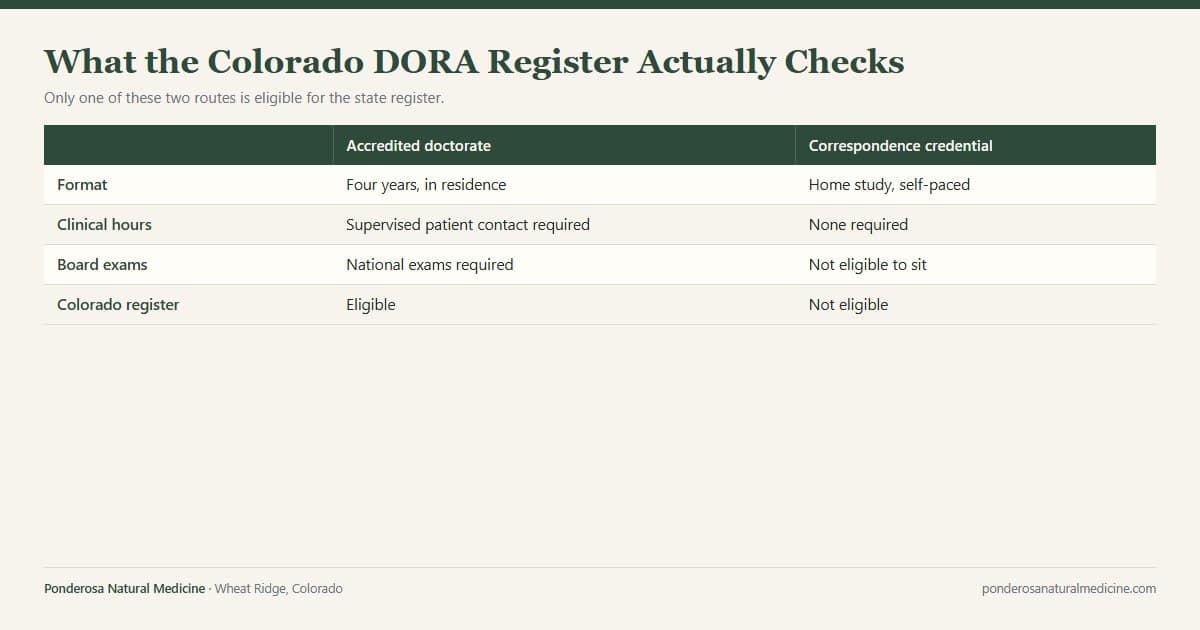
A correspondence credential is something else entirely. Distance programs exist that issue an “ND” or “NMD” after coursework completed at home, with no supervised clinical hours and no route into the national board exams. Some are inexpensive. Some are quick. None of them qualify a graduate to register in Colorado.
Accredited doctorate
Correspondence credential
Format
Four years, in residence
Home study, self-paced
Clinical hours
Supervised patient contact required
None required
Board exams
National exams required
Not eligible to sit
Colorado register
Eligible
Not eligible
You can’t tell these apart from a homepage. Both sets of graduates use similar language about root causes and whole-person care, and both may look polished. The register is what separates them, which is why naturopathic doctors in Colorado who did the accredited route tend to name their school openly.
<a id=”verify”></a>
How to Verify a Registration Yourself
Start with DORA’s online lookup for the Division of Professions and Occupations. Search the practitioner’s name, confirm the status reads as active, and check whether any disciplinary action is attached to the record. It takes about as long as looking up a restaurant.
Three follow-ups worth making before you book:
Ask which naturopathic medical school they attended, and whether it was in residence.
Ask whether they sat the national board examinations.
Ask what they refer out, and to whom.
A registered practitioner answers all three without hesitation, since the answers are already a matter of public record. Hedging on any of them tells you something.
Do the lookup before the first appointment rather than after. Naturopathic doctors in Colorado are simple to confirm in advance and awkward to interrogate once you’re already sitting in the room with your shoes off.
Watch the wording on websites too. “Doctor” on its own is doing no work, and neither are phrases like certified wellness professional or board certified in natural health, which sound official and point at no state standard whatsoever. If you want the training behind a specific practitioner, it should be published where you can find it, the way Dr. Wallace’s credentials and DORA registration are.
<a id=”title-protection”></a>
What Title Protection Does and Does Not Cover
Title protection is narrower than most patients assume, and understanding the edges of it saves you from a false sense of security.
Here’s what it does. The state restricts the naturopathic doctor titles to people on the register, so someone who has not met the education and examination standard can’t hold themselves out under those titles in Colorado. That’s a real protection with real teeth.
Here’s what it doesn’t do. It doesn’t reach titles that sit outside the act. Wellness consultant, holistic practitioner, natural health advisor, health coach and similar descriptions are unregulated in Colorado, and anyone may use them tomorrow morning with no training at all. Many people using those titles are thoughtful and honest. The point is that the state isn’t vouching for any of them.
Registration is a floor rather than a ceiling. It confirms that naturopathic doctors in Colorado met a defined standard of education and examination, and it says nothing about bedside manner, communication, or whether a particular practitioner is the right fit for your case. You still have to do that part yourself. The exact list of protected titles is published by DORA, and that’s the list to check if a credential on a website looks ambiguous.
<a id=”homeopathic”></a>
Homeopathic Doctors in Colorado Are a Separate Question
Searches for homeopathic doctors in Colorado run at similar volume to naturopathic ones, and the two get treated as interchangeable constantly. They aren’t.
Homeopathy is a specific discipline built on highly diluted preparations and its own prescribing logic. Naturopathic medicine is a broader training that covers nutrition, botanical medicine, physical medicine, diagnostics and lab interpretation. Some naturopathic doctors use homeopathy in practice. Many don’t, and the degree doesn’t require it.
Ponderosa Natural Medicine sits in the second group. What’s offered here is Custom Herbal Medicine, which uses plant material at meaningful doses and belongs to an entirely different tradition than homeopathic preparations. The two are not versions of the same thing, and neither the National Center for Complementary and Integrative Health nor any naturopathic program treats them as one field.
If you searched for a homeopath and landed here, the useful question isn’t which label you typed. It’s what you’re trying to sort out. Digestive complaints, thyroid questions, hormone patterns and stubborn fatigue are the concerns naturopathic doctors in Colorado see most often, and those are the ones worth bringing to a first appointment.
<a id=”first-visit”></a>
What Any of This Changes About Your First Visit
Concretely, not much, which is the point. Registration is background infrastructure, and you feel it mostly as an absence of doubt about who you’re sitting with.
A first appointment with a registered ND runs long by conventional standards. Expect a full history, a look at any recent labs you have, and questions about sleep, digestion, stress and diet that a fifteen-minute visit never has room for. Functional lab testing may follow. Herbal formulas, nutrition changes and supplement protocols come after the picture is clear, not before.
Dr. Karrina Wallace practices at 4251 Kipling Street, Suite 160 in Wheat Ridge, seeing patients from Denver, Aurora, Littleton, Lakewood, Arvada, Golden, Evergreen and the wider Denver Metro, with telehealth available statewide. She has served on the board of the Colorado Association of Naturopathic Doctors since 2015 and was a Board Director from 2023 to 2025.
That last detail is worth a sentence of its own. Board service means someone has spent a decade inside the conversations about how naturopathic doctors in Colorado are regulated, which is a different kind of familiarity with DORA than reading the website once.
This article is educational and isn’t a substitute for individual medical advice. Bring your own situation to a practitioner who can assess it.
<a id=”faqs”></a>
FAQs About Naturopathic Doctors in Colorado
Are naturopathic doctors in Colorado licensed or registered?
Registered. Colorado uses a registration model administered by DORA rather than a full licensure model, which means the state verifies education and board examinations, protects the professional title, defines a scope of practice, and handles complaints. Several other states license naturopathic doctors instead, granting a wider clinical scope. The register is public and searchable at DORA.
How do I check whether a naturopathic doctor is registered with DORA?
Use the online lookup run by DORA’s Division of Professions and Occupations. Search the practitioner’s name, then confirm that the record exists, that the status reads active, and that no disciplinary action is attached. The search is free and takes a minute or two. If a name doesn’t appear at all, ask the practitioner directly before booking anything.
Can naturopathic doctors in Colorado prescribe medication?
No. Registered naturopathic doctors in Colorado aren’t licensed to prescribe conventional pharmaceuticals. Care is built around nutrition, botanical medicine, lifestyle change, physical medicine and lab interpretation. A registered ND works alongside your prescribing physician rather than replacing them, and should refer you out when a situation calls for medication, imaging or specialist care.
Do I still need a primary care doctor?
Yes. A registered ND in Colorado isn’t a replacement for primary care, urgent care or emergency medicine, and reputable practitioners say so plainly. Many patients keep their existing physician and add naturopathic care for nutrition, digestive, hormonal or energy concerns that need longer appointments and a different set of tools than a standard visit allows.
Are homeopathic doctors in Colorado regulated the same way?
Homeopathy is a distinct discipline rather than a state-registered profession in Colorado, so the DORA register for naturopathic doctors doesn’t cover it. A registered ND may or may not practice homeopathy, since the doctorate doesn’t require it. Ponderosa Natural Medicine offers Custom Herbal Medicine, which uses plant material at therapeutic doses and is a different discipline from homeopathy.
<a id=”book”></a>
Book With a Registered Naturopathic Doctor
Check the register first. Naturopathic doctors in Colorado are listed publicly for exactly this reason, so use it. Then book with whoever earns your trust after you’ve read it.
If that turns out to be Ponderosa, Dr. Wallace sees patients in Wheat Ridge and by telehealth across Colorado, with appointment lengths built for the kind of history-taking this work actually needs. You can book my first appointment online, or read through what each service covers before you decide.
Verified training, a public registration, and a practitioner who tells you where her scope ends. Start there.
Ready to Better Understand Your Stress Response?
You do not have to keep pushing through fatigue, burnout, poor sleep, or stress-related symptoms without answers. If you are ready for a more thorough evaluation, Ponderosa Natural Medicine can help you take the next step.