Herbs That Fight Infection: A Clear Bacterial vs Viral Guide
Antibacterial and antiviral are two separate jobs, and the supplement aisle blurs them into one.
Strep throat and a head cold can feel identical on day one. Sore throat, low energy, a bit feverish. One is bacterial. The other is viral. The herbs that fight infection in those two situations are not interchangeable, and very little of what sits on a shelf tells you which group it belongs to. This post sorts the groups apart. You get the biology in plain terms and an honest read on where the human evidence holds up. Then the situations where reaching for a bottle first is the wrong call, since those matter more than any list of plants.
Table of Contents
Bacterial and Viral Infections Are Not the Same Problem
What Do Herbs That Fight Infection Actually Do?
Antibacterial Plants and Where the Evidence Sits
Herbs for Infections That Are Viral, Not Bacterial
What Anti Infection Herbs Cannot Do
When Using Herbs to Fight Infection Is Risky
How a Naturopathic Doctor Builds a Custom Formula
FAQs About Herbs That Fight Infection
Bacterial and Viral Infections Are Not the Same Problem
Bacteria are complete living cells. They carry an outer wall, their own machinery for building protein, and they multiply on their own inside your tissue. Damage the wall or jam the machinery and the organism dies.
Viruses have none of that.
A virus is a strand of genetic code wrapped in protein, and it cannot copy itself, so it hijacks your own cells and forces them to assemble new copies until the cell finally bursts. There is no wall to rupture and no metabolism to poison. That is the reason an antibiotic aimed at bacterial ribosomes does nothing whatsoever to influenza.
Plants follow the same rules. Carvacrol, the compound behind oregano’s antibacterial reputation, works by pulling bacterial membranes apart. Point it at a virus and there is no membrane of that kind waiting for it.
So an herb tested against a flu strain in a lab has told you nothing about how it behaves against Streptococcus, and the reverse holds just as firmly. That one point clears up most of the confusion in this topic. People search “infection” and mean both. Labels say “immune support” and commit to neither.
Your clinician separates the two with a swab, a culture, or a blood count. Guessing from symptoms alone gets unreliable quickly, once you move past the obvious cases.
Green mucus does not mean bacteria. Neither does a sore throat, a cough that has hung around for ten days, or a fever that spikes at night. Those signs come from your immune response, which behaves much the same whichever invader triggered it.
Which is why herbs that fight infection should be chosen after the bacterial or viral question is settled, not before it. Order matters more here than potency does.
What Do Herbs That Fight Infection Actually Do?
Herbs that fight infection work in one of three ways. Some damage bacteria directly. Some interfere with a virus entering or copying itself inside your cells. Most of the popular ones do neither, and act on your own immune response instead. Those mechanisms are not interchangeable, and the front of the bottle rarely tells you which one you bought.
Category
What it acts on
Commonly cited plants
Antibacterial
The bacterium itself
Garlic, oregano, berberine plants
Antiviral
Viral entry or replication
Elderberry, licorice root, lemon balm
Immunomodulating
Your own immune response
Astragalus, echinacea, medicinal mushrooms
That third row is where most products in the immune section of a shop actually live. An immunomodulating plant does not attack anything. It nudges the response your body was already mounting, which can matter, and which is a different claim from killing a pathogen.
Worth knowing before you read another label. “Antimicrobial” is an umbrella term covering bacteria, viruses, fungi, and parasites all at once, so it sounds broad and specifies nothing.
There is a fourth thing plants do that rarely gets its own row. Some ease symptoms without touching the pathogen or your immune response, which is what thyme does when it loosens a cough and what marshmallow root does when it coats a raw throat. Comfort is a legitimate goal. It is not the same as fighting an infection, and a product can deliver the first and imply the second.
Antibacterial Plants and Where the Evidence Sits
The honest summary is that laboratory data is plentiful and human data is thin.
Garlic is the classic case. Allicin, the sulfur compound released when a clove is crushed, shows wide antibacterial activity in culture. Swallow a tablet and much of that allicin has already degraded. Oregano’s aromatic oil behaves the same way on paper and faces the same problem in a person.
The concentration of carvacrol that wipes out a bacterial colony in a dish runs far higher than anything your bloodstream sees after a capsule, and that gap is where most label claims fail.
Berberine is the interesting exception. Found in goldenseal, Oregon grape and barberry, it absorbs poorly from the gut, which sounds like a flaw. For infections sitting in the gut, poor absorption means the compound stays where the problem is. Berberine has been studied in humans for bacterial diarrhea, and that is a narrower and more believable claim than “kills bacteria.”
Cranberry is often filed here by mistake. Its proanthocyanidins appear to stop bacteria sticking to the bladder wall, which is prevention of recurrence rather than treatment of an active infection. Useful distinction. It changes when you would use it.
Route of delivery does a lot of quiet work in this category. Manuka honey applied to a wound and thyme oil used in a steam both keep the active compound at the site, at a strength a swallowed capsule will never reach systemically. That is the pattern worth noticing across the antibacterial herbs that fight infection locally. They perform best where you can put them directly against the problem, which means skin, gut, mouth, and airway.
Everything else in this group asks you to trust that a diluted, partly digested version of a laboratory result still does something. The trials to confirm that mostly have not been run.
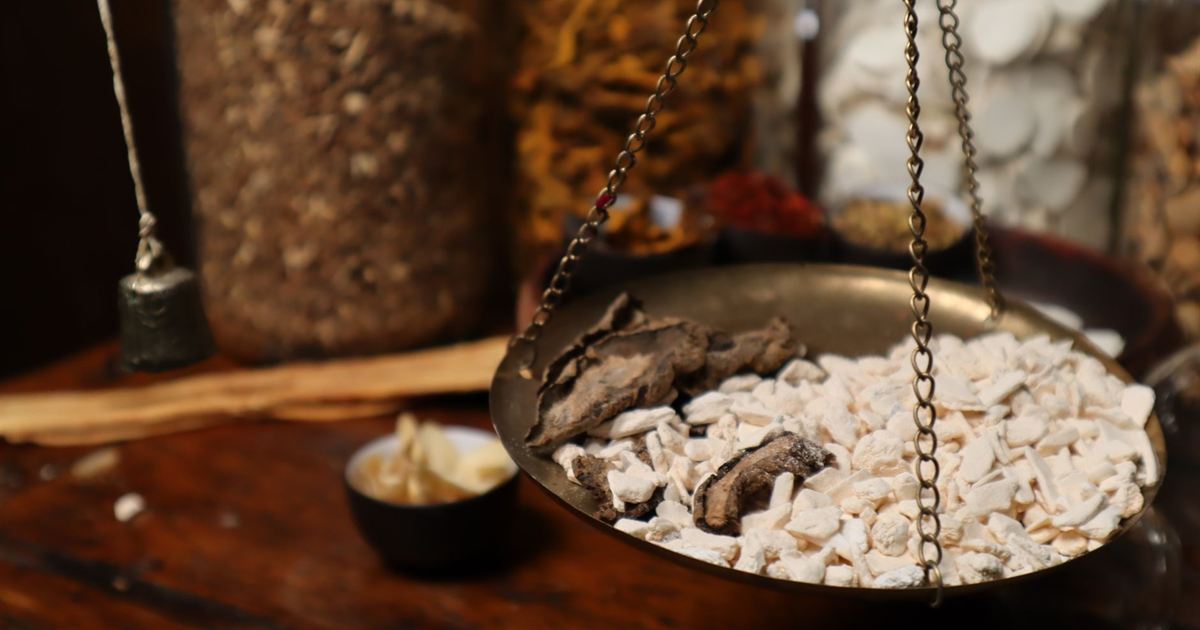
!Dried botanicals weighed out for a custom blend of herbs that fight infection
Herbs for Infections That Are Viral, Not Bacterial
Timing decides almost everything on this side.
Antiviral plants are studied for blocking a virus from entering cells or from replicating once inside. Both of those happen early. If you are five days into a cold, that window shut before you opened the cupboard, and no dose fixes the timing.
Elderberry carries the most human trial data of the group, tested against influenza and common cold symptoms in randomized studies indexed on PubMed. Andrographis has been trialled for upper respiratory symptoms. Lemon balm is applied topically for cold sores rather than swallowed, and the herpes work behind it is more consistent than most.
Echinacea is an example of how messy this gets, since trials use different species, different parts of the plant, and different extraction methods, then get pooled as though they tested one product. Two echinacea bottles can be chemically unalike.
Licorice root deserves a caution alongside its antiviral reputation. Glycyrrhizin raises blood pressure and drops potassium in some people, so it is not a casual daily choice.
Shingles and recurrent cold sores raise a separate question, since both come from viruses that never leave the body and reactivate under stress. Antiviral herbs are studied against the flare, not against the dormant virus, and no plant clears a herpes family virus from your nerve tissue. Anyone claiming otherwise is selling something.
None of these are herbs for infections caused by bacteria. Taking elderberry for strep is a category error, not a weak strategy.
What Anti Infection Herbs Cannot Do
Here is the boundary, stated plainly.
Herbs that fight infection cannot be assumed to reach, inside your body, the concentrations that produced the laboratory result quoted on the marketing page. They cannot substitute for antibiotics in strep throat, in a bladder infection climbing toward the kidneys, in cellulitis, or in pneumonia. Untreated strep carries a small but real risk of damage to the heart valves, and that risk is not worth managing with a tincture.
They cannot treat what nobody has identified yet. A plant chosen for the wrong pathogen is not a gentle version of the right answer.
“Broad spectrum” on a label is marketing language, not a lab finding
Species, plant part, and extraction method change the chemistry entirely
Standardization varies widely across brands at the same shelf price
Quantity on the panel tells you nothing about absorption
One more limit. Several of the strongest antibacterial plants hit your gut bacteria as hard as they hit anything else, and long unsupervised courses can leave digestive health worse than the original complaint.
Cost is worth naming too. A month of a well-standardized extract often runs past the equivalent prescription with insurance, and paying more buys you contents that match the panel. Not a stronger claim.
When Using Herbs to Fight Infection Is Risky
Some combinations belong under supervision, full stop.
St John’s wort speeds up the liver enzymes that clear many prescriptions, which lowers blood levels of antivirals, hormonal contraception, transplant medication, and more. The interaction is well documented at the National Center for Complementary and Integrative Health. Immune-stimulating plants sit awkwardly with autoimmune conditions and with immunosuppressant drugs, for the obvious reason. Pregnancy narrows the safe list sharply.
Then there are the moments when no herb is the answer and delay itself is the danger. Get medical care the same day for any of these.
Fever that climbs after several days, or returns after breaking
Stiff neck, confusion, or a rash that does not fade under pressure
Trouble breathing, chest pain, or a spreading area of red skin
Severe one-sided throat pain with difficulty swallowing
Any infection in someone pregnant, elderly, or immunocompromised
Symptoms that improve and then sharply worsen deserve the same urgency. That pattern often means a bacterial infection has taken hold behind a viral one.
Children change the calculation as well. Dosing does not scale down neatly by body weight, several plants have no pediatric safety data at all, and a young child cannot tell you when something feels wrong in the way an adult can. Ask before you give, rather than after.
Used sensibly, herbs that fight infection sit alongside conventional treatment. They run into trouble when they are used to postpone it.
How a Naturopathic Doctor Builds a Custom Formula
Matching happens before dosing.
At Ponderosa Natural Medicine in Wheat Ridge, Custom Herbal Medicine starts with an intake and, where it helps, functional lab testing to clarify what is driving the pattern. Registered naturopathic doctors in Colorado are regulated by the Department of Regulatory Agencies, and that registration defines the scope of what an ND can and cannot do here.
A formula built for you accounts for the suspected category, your current prescriptions, your gut, and your history. Dr. Karrina Wallace, ND sees patients across Wheat Ridge, Denver, Arvada, Lakewood, Golden and Littleton, with telehealth available statewide in Colorado.
Recurrence is where this approach earns its keep. Someone catching four sinus infections a year usually has something upstream driving it, whether that is nutrient status, blood sugar, thyroid function, or a gut that never recovered from a previous antibiotic course. Choosing herbs that fight infection during each episode treats the episode. Finding the pattern underneath is a different piece of work.
The work is rarely one heroic plant. It is the right category, at a sane dose, alongside conventional care rather than instead of it.
This article is educational and is not a substitute for individual medical advice, diagnosis, or treatment.
FAQs About Herbs That Fight Infection
Which herbs that fight infection have the strongest human evidence?
Elderberry has the most published human trial data among the antiviral group, studied for influenza and common cold symptoms. Berberine has human research behind its use in bacterial diarrhea. Most other candidates rest on laboratory and animal work, which shows activity in a dish without proving the same effect happens in a person at a normal oral dose.
Can herbs replace antibiotics for a bacterial infection?
No. Confirmed bacterial infections such as strep throat, cellulitis, pneumonia, and kidney infections need antibiotic treatment, and delaying it carries real risk. Herbs that fight infection can sit alongside conventional care, chosen so they do not interact with your prescription. That decision belongs with a clinician who can see your full medication list.
Do antiviral herbs still work once symptoms have started?
Antiviral plants are studied at the earliest stage, when a virus is entering cells or beginning to replicate. Starting within the first day or two is where the trial evidence sits. Several days in, your immune system is already running the response, and immune-supporting and symptom-easing approaches make more sense than a late antiviral attempt.
Are anti infection herbs safe with prescription medication?
Not automatically. St John’s wort lowers blood levels of many drugs by speeding up liver clearance. Licorice affects blood pressure and potassium. Immune-stimulating plants can conflict with immunosuppressants. Bring every supplement bottle to your appointment, since interaction checking is straightforward once someone can see the whole list.
How do I know whether my infection is bacterial or viral?
You often cannot tell from symptoms alone, which is why testing exists. A throat swab, urine culture, or blood count answers the question directly. Choosing between herbs that fight infection of one type or the other without that answer is guesswork, and the wrong guess costs you time you may not have.
Talk Through Your Options With a Naturopathic Doctor
Bring the bottles you already own and the questions you have not been able to answer online.
Dr. Wallace works through what fits your situation, what conflicts with your prescriptions, and what belongs to conventional care instead. Book my appointment in Wheat Ridge and get a plan built around your history rather than a shelf label.
Ready to Better Understand Your Stress Response?
You do not have to keep pushing through fatigue, burnout, poor sleep, or stress-related symptoms without answers. If you are ready for a more thorough evaluation, Ponderosa Natural Medicine can help you take the next step.