Antiviral Herbal Supplement: 6 Label Mistakes to Avoid
[The front of the bottle is advertising. The back of the bottle is the product.]
The front label sells. The back label tells.
Walk the supplement aisle at any store in the Denver metro and you will find two dozen bottles promising immune support, most of them carrying the same short list of herb names. Prices run from 9 dollars to 60 for things that look identical from the front. What separates them is printed on the back in six point type, in a vocabulary nobody explains at the register. Reading an antiviral herbal supplement label properly is a twenty minute skill, and it comes down to four questions. What part of the plant went in, how concentrated it is, how much you actually get per serving, and who verified any of it.
Table of Contents
What Counts as an Antiviral Herbal Supplement?
Standardized Herbal Extract or Whole Herb Powder
What an Extract Ratio Like 10 to 1 Means
Plant Part Changes What You Get
Third Party Testing Marks on Supplement Labels
Proprietary Blends and the Doses They Hide
Why “Supports Immune Health” Is a Structure Function Claim
6 Label Mistakes That Cost You Money
Where Antiviral Herbal Supplements Fit in Naturopathic Care
FAQs About Choosing an Antiviral Herbal Supplement
What Counts as an Antiviral Herbal Supplement?
An antiviral herbal supplement is a dietary supplement built around plant material that has been studied for activity against viruses. Under the Dietary Supplement Health and Education Act of 1994, it is regulated as a food rather than a drug. No agency clears it for safety or effect before it reaches a shelf.
That surprises most people. The Food and Drug Administration can act against a product once it is on the market, and it does not review formulas beforehand. The manufacturer holds the legal duty to make its own product safe and to label it honestly.
So the label is a résumé written by the applicant.
Which is why the Supplement Facts panel deserves more attention than the artwork above it. Serving size, amount per serving, and the part of the plant each botanical came from are all required there. The Latin binomial is optional, so a bottle that skips it has made a choice.
Standardized Herbal Extract or Whole Herb Powder
Two bottles, one herb, two genuinely different products.
Whole herb powder is dried plant material, milled and capsuled. You get the full spread of compounds in whatever proportion that harvest produced, which shifts with soil, rainfall and picking time. A standardized extract runs the plant through a solvent, concentrates what dissolves, and then guarantees a fixed percentage of one marker compound in every batch.
Elderberry gets standardized to anthocyanins. Astragalus to polysaccharides. Andrographis to andrographolides.
Neither format wins outright. Standardization buys you a dose you can repeat, and much of the published human research on PubMed used standardized preparations. Matching the form gets you nearer the conditions that were tested. Whole herb keeps constituents the marker never measured, and it usually costs less.
The catch sits inside the marker itself. It is a proxy, chosen partly for being easy to quantify, and it is not proof that the plant’s activity lives in that one molecule. A label reading “standardized to 5% andrographolides” tells you 5% of the extract’s weight is one compound. It says nothing about the other 95%.
One more phrasing check. “Standardized extract” with no marker and no percentage named is marketing, not a specification.
What an Extract Ratio Like 10 to 1 Means
Start with the arithmetic. A 10 to 1 ratio means 10 kilograms of raw dried herb were processed down into 1 kilogram of finished extract, so a 300mg capsule gets marketed as 3,000mg of herb equivalent.
Bigger numbers look stronger. They frequently are not.
Ratios lean on the starting material. A plant with low solid content yields a dramatic looking ratio without much happening chemically, and the ratio says nothing about which compounds survived the solvent and heat. Two 10 to 1 elderberry extracts from different makers can carry very different anthocyanin content.
Then there is dilution. Many extracts are produced at a native ratio, then blended with a carrier such as maltodextrin or rice flour so they run through capsule machinery. A native 10 to 1 extract cut half and half with carrier is functionally a 5 to 1 product, and the bottle will still say 10 to 1.
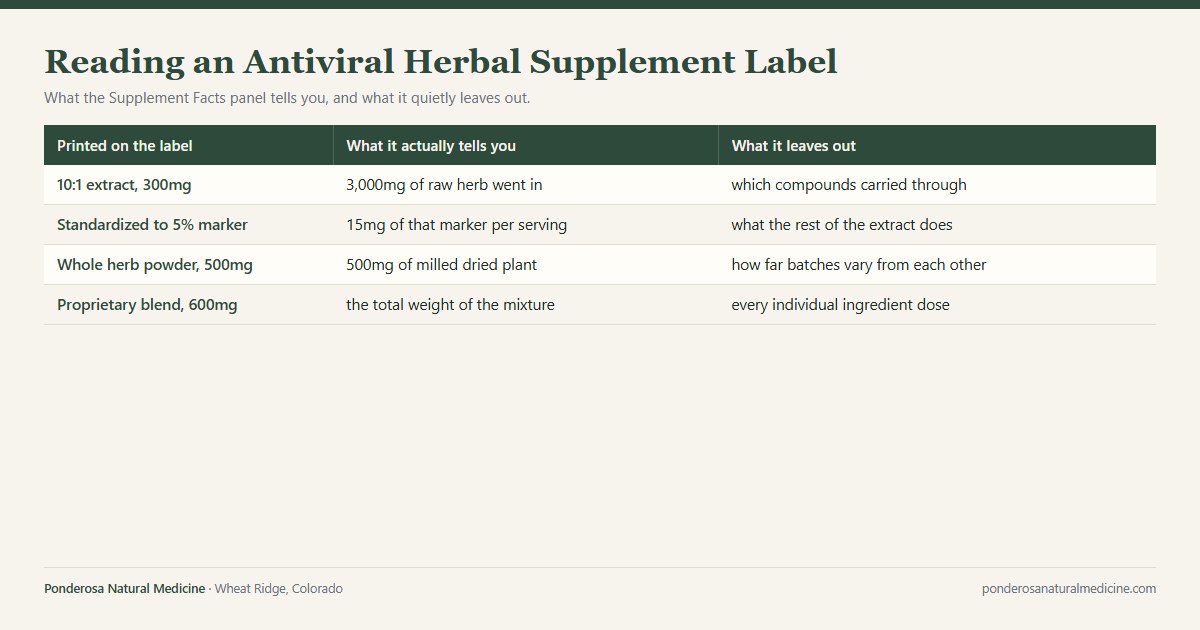
Printed on the label
What it actually tells you
What it leaves out
10:1 extract, 300mg
3,000mg of raw herb went in
which compounds carried through
Standardized to 5% marker
15mg of that marker per serving
what the rest of the extract does
Whole herb powder, 500mg
500mg of milled dried plant
how far batches vary from each other
Proprietary blend, 600mg
the total weight of the mixture
every individual ingredient dose
Buy on marker content wherever it is disclosed and treat ratios as secondary. An antiviral herbal supplement that names its marker and percentage hands you a number you can compare across brands. A ratio alone compares to nothing.
Plant Part Changes What You Get
Root and leaf are not interchangeable.
Echinacea is the clearest case. Alkylamides concentrate in the root, and the polysaccharide fraction sits more in the aerial parts, the stems and flowers above ground. A product listing “Echinacea purpurea herb” and one listing “Echinacea angustifolia root” are chemically different purchases sold at similar prices.
Elderberry carries a safety angle on top of that. Ripe cooked fruit of Sambucus nigra is what belongs in syrups and extracts, and the leaves, stems and unripe berries contain cyanogenic glycosides that can make people ill. A careful label says “fruit.” A vague one says “elderberry.”
Species matters as much as part does. Sambucus nigra and Sambucus canadensis are close relatives with different research behind them, and Astragalus membranaceus is used as root rather than leaf. The National Center for Complementary and Integrative Health publishes plain language herb summaries naming species and parts, which is a fast way to check a bottle independently.
If a panel lists a botanical without naming the part, that ends the evaluation for me. Part disclosure is the cheapest honesty a manufacturer can offer. Leaving it out signals a company that either does not know or would rather not say.
Third Party Testing Marks on Supplement Labels
A testing mark verifies what is in the bottle. It says nothing about what the bottle does.
Look for NSF International, USP Verified or Informed Choice. Those programs test finished product for ingredient identity, label claim potency, and contaminants including heavy metals, pesticide residue and microbial load. Several audit the manufacturing site on a schedule. None assess whether an antiviral herbal supplement works.
“Manufactured in a GMP facility” is not a distinguishing claim. Current Good Manufacturing Practice rules for supplements have been federal law since 2007 under 21 CFR Part 111, so every legitimate manufacturer already has to comply. Third party GMP registration brings in an outside auditor, which is a real step up. Compliance alone is the floor.
Then ask for a Certificate of Analysis. Good companies send the lot specific COA showing identity, potency and contaminant results for the batch you are holding, and the lot number should match your bottle. A company that cannot produce one has answered your question anyway.
Verify the mark on the certifier’s own website. Logos get copied.
Proprietary Blends and the Doses They Hide
This is where most supplement money quietly gets wasted.
Federal labeling rules let a manufacturer group ingredients into a proprietary blend, print one combined weight, and list them in descending order by weight without disclosing individual amounts. A “600mg Immune Defense Blend” is perfectly legal and tells you close to nothing.
Run the worst case. If that blend holds eight herbs and the one you came for is listed sixth, your actual dose might be 5mg where clinical work used 300mg. Order is your only clue, and it will not reveal whether the first ingredient is 90% of the weight or 20%.
Sometimes a blend is defensible. A formula built on traditional pairings, where a practitioner can explain the ratio, is a different animal from a list assembled to look impressive. That reasoning is what Custom Herbal Medicine provides and a retail blend cannot.
Still, when two products cost the same and only one discloses every dose, the decision makes itself. An antiviral herbal supplement worth your money shows its work.
Why “Supports Immune Health” Is a Structure Function Claim
That phrase is a legal category, not a research finding.
DSHEA permits supplement labels to carry structure function claims, which describe an effect on the normal structure or function of the body. “Supports immune health” qualifies. “Maintains healthy respiratory function” qualifies. The company has to notify the FDA within 30 days of first marketing such a claim. It must then print the standard disclaimer, which says the claim has not been evaluated by the FDA and the product is not intended to diagnose, treat, cure or prevent any disease.
What a label legally cannot say is that the product treats influenza, shortens a cold or kills a virus. Those are disease claims, and a disease claim turns the product into an unapproved drug.
So read the softness correctly. A cautious claim is a compliant claim, not a weak product.
The reverse is more useful. A bottle promising to “fight viral infection” belongs to a company willing to break a rule you can check, which is worth knowing before you trust the rules you cannot. Judge an antiviral herbal supplement on identity, part, dose and verification instead.
6 Label Mistakes That Cost You Money
Most of what goes wrong at the shelf repeats itself. These six account for the bulk of it.
Comparing milligrams across different forms. 500mg of powder and 500mg of a concentrated extract are not the same purchase.
Reading a large extract ratio as potency. Ratios describe processing, not activity, and carriers dilute them afterwards.
Skipping the plant part. Root, leaf, flower and fruit carry different compounds and different safety profiles.
Treating GMP as a seal of quality. It is a legal minimum, not an achievement worth paying for.
Accepting a proprietary blend. Undisclosed doses cannot be compared against research or against another brand.
Buying on the front panel. The artwork is written by marketing. The Supplement Facts box is written by regulation.
An antiviral herbal supplement that clears all six usually costs more per bottle and less per useful dose.
Where Antiviral Herbal Supplements Fit in Naturopathic Care
Label literacy solves half the problem. Whether the herb suits you is the other half, and no bottle can answer that.
Herbs interact with prescriptions in ways that matter clinically. St. John’s wort induces the CYP3A4 enzyme and can lower blood levels of many medications, oral contraceptives among them. Licorice root containing glycyrrhizin can raise blood pressure and drop potassium when taken at length. Dose, duration and form have to match the person holding the bottle.
That matching is the work behind Custom Herbal Medicine at Ponderosa Natural Medicine in Wheat Ridge, where Dr. Karrina Wallace, ND builds formulas around your history, your medications and your goals.
Ponderosa’s Quality Nutritional Supplements service removes much of the guesswork this article describes, since practitioner channel products arrive with sourcing and testing documentation already reviewed.
This article is educational and is not a substitute for individual medical advice. Talk to a licensed practitioner before starting or stopping anything, particularly if you take prescription medication.
FAQs About Choosing an Antiviral Herbal Supplement
What is the strongest antiviral supplement?
No single product owns that title, and any label claiming it is worth walking away from. Strength depends on the herb, the extract concentration, the disclosed dose and how consistently you take it. A standardized elderberry extract at a researched dose is a far more defensible purchase than a stronger sounding proprietary blend that hides its amounts.
How do I know if an antiviral herbal supplement has been third party tested?
Look for an NSF, USP Verified or Informed Choice mark on the bottle, then confirm the product on the certifier’s own website, since marks get copied onto packaging that was never tested. Request the lot specific Certificate of Analysis and match the lot number to your bottle. A company unwilling to share one has told you what you needed to know.
Does a higher extract ratio mean a better antiviral herbal supplement?
Not on its own. A 10 to 1 ratio describes how much raw herb went into the extract, not how much active compound came out the other side. Carriers dilute ratios after processing too, so a native ratio and a finished ratio can differ. Standardized marker percentages give you a number that compares between brands, and ratios do not.
Can I take an antiviral herbal supplement with prescription medication?
Ask your prescriber or a naturopathic doctor first, every time. Some herbs change how your body processes drugs. St. John’s wort speeds up the CYP3A4 enzyme and can lower blood levels of many medications, and licorice containing glycyrrhizin can raise blood pressure with sustained use. Interactions depend on your specific prescriptions, your doses and how long you take both.
How long should I take an antiviral herbal supplement?
It depends on the herb and on your reason for taking it. Some are used briefly around an acute illness, and others are taken across weeks as tonics. A few, licorice among them, carry duration limits tied to known side effects rather than tradition. Set that timeline with a clinician who knows your history instead of following a bottle.
Is an expensive antiviral herbal supplement always better?
Price tracks disclosure more than it tracks effect. Standardization testing, third party verification and lot specific certificates all cost the manufacturer money, and those costs reach the shelf. A cheap bottle with a named species, a named plant part, a disclosed dose and a verification mark beats an expensive one hiding behind a blend.
Get My Supplement Questions Answered
You have a bottle in your hand and a question the label cannot answer. Bring it in.
Appointments at Ponderosa Natural Medicine cover what you already take, what it interacts with, and whether a different form or dose fits you better. Dr. Karrina Wallace, ND sees patients at 4251 Kipling Street, Suite 160 in Wheat Ridge, and serves Denver, Aurora, Littleton, Lakewood, Arvada, Golden, Evergreen and the surrounding Denver Metro, with telehealth available statewide in Colorado.
Book my appointment and get a straight answer about the antiviral herbal supplement you are considering.
Ready to Better Understand Your Stress Response?
You do not have to keep pushing through fatigue, burnout, poor sleep, or stress-related symptoms without answers. If you are ready for a more thorough evaluation, Ponderosa Natural Medicine can help you take the next step.