What Herbs Are Antiviral? An Honest, Evidence-Based List
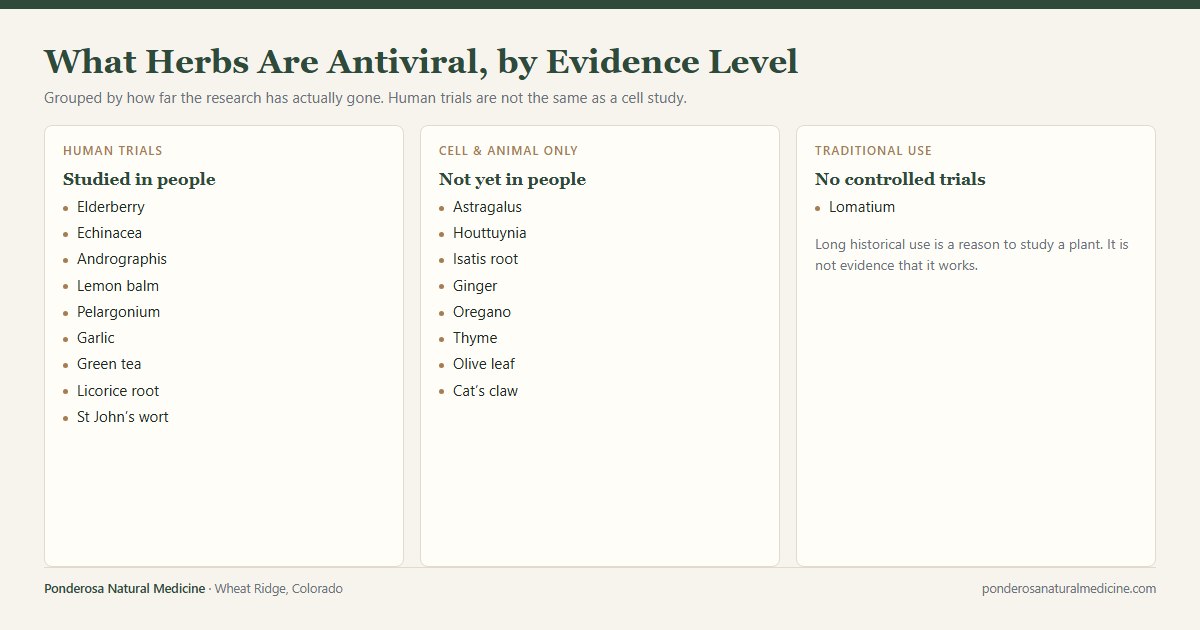
Every plant below has published antiviral research behind it. The second column tells you whether that research ever involved a human being.
Most antiviral herb lists share one flaw. Every plant gets the same treatment, so elderberry sits shoulder to shoulder with a plant that has only ever met a virus in a dish on a lab bench.
That gap is not a technicality. One herb shortened symptoms in people who volunteered for a trial. The other slowed viral replication in cultured cells, at a concentration you would never reach by swallowing a capsule.
So this post answers what herbs are antiviral by splitting the list in two. One group tested in people, one group tested in cells or animals only. Common name and botanical name for each, since supplement labels use both and they do not always agree.
Table of Contents
What Herbs Are Antiviral? The Short Answer
The Antiviral Herbs List, Sorted by Evidence Level
Herbs That Are Antiviral in Human Studies
Antiviral Activity in a Dish Is Not the Same as in a Person
How These Herbs Are Actually Used
Safety, Interactions and Who Should Skip Them
Where Custom Herbal Medicine Fits
FAQs on What Herbs Are Antiviral
<a id=”short-answer”></a>
What Herbs Are Antiviral? The Short Answer
Elderberry, echinacea, andrographis, lemon balm, pelargonium, garlic and licorice have all been studied in human trials for viral illness. Dozens more, including oregano, olive leaf, ginger and cat’s claw, carry published antiviral activity in cell culture only. Both groups are real research. Only one of them tells you what happens inside a person.
That second sentence is the part almost every listicle drops.
A plant earns the word antiviral in the scientific literature the moment it interferes with a virus in a controlled experiment, and that experiment can be a petri dish. Nobody is lying when they call oregano oil antiviral. They are just quoting a study you would read very differently if you saw the methods section.
<a id=”the-list”></a>
The Antiviral Herbs List, Sorted by Evidence Level
Here is the reference table. It answers what herbs are antiviral at two very different levels of confidence, and the evidence column is where you should look first. Botanical names are included since two herbs sold under the same common name are often different plants, and the botanical name on the label is the only thing that settles it.
!Reference table showing what herbs are antiviral in human trials versus cell studies
Common name
Botanical name
Evidence level
Studied for
Elderberry
Sambucus nigra
Human trials
Cold and influenza symptom duration
Echinacea
Echinacea purpurea
Human trials
Common cold frequency and duration
Andrographis
Andrographis paniculata
Human trials
Upper respiratory tract infection symptoms
Lemon balm
Melissa officinalis
Human trials, topical
Herpes simplex cold sores
Pelargonium (umckaloabo)
Pelargonium sidoides
Human trials
Acute bronchitis and cold symptoms
Garlic
Allium sativum
Human trials, small
Cold frequency and recovery
Green tea
Camellia sinensis
Human data, limited
Influenza prevention, small studies
Licorice root
Glycyrrhiza glabra
Human data, hospital setting
Intravenous glycyrrhizin in viral hepatitis
St John’s wort
Hypericum perforatum
Human trials, disappointing
Hypericin tested as an antiviral in HIV
Astragalus
Astragalus membranaceus
Animal and cell, thin human data
Immune signaling and viral replication
Houttuynia
Houttuynia cordata
Cell and animal only
Herpesviruses and coronaviruses in culture
Isatis root
Isatis indigotica
Cell and animal only
Influenza in culture and animal models
Ginger
Zingiber officinale
Cell only
Respiratory syncytial virus in culture
Oregano
Origanum vulgare
Cell only
Carvacrol against enveloped viruses
Thyme
Thymus vulgaris
Cell only
Thymol against enveloped viruses
Olive leaf
Olea europaea
Cell only
Oleuropein and viral entry in culture
Cat’s claw
Uncaria tomentosa
Cell only
Viral replication in culture
Lomatium
Lomatium dissectum
Traditional use, no controlled trials
Respiratory viral illness, historical use
Eighteen plants, three honest tiers. You can search any of these by botanical name at PubMed and read the abstracts yourself, which is a better use of ten minutes than another blog post.
<a id=”human-studies”></a>
Herbs That Are Antiviral in Human Studies
Seven plants carry the strongest end of the evidence. None of them is a cure, and the honest summary for most is that they shifted symptoms modestly in people who took them early.
Elderberry (Sambucus nigra)
Elderberry has the most human data of the group. Randomized trials have looked at standardized elderberry extract in influenza and in colds, and the outcome measured is usually symptom duration or symptom severity rather than whether the virus was eliminated. Timing matters more than dose here, since the trials started treatment within the first day or two of symptoms.
Raw elderberries, leaves and bark are a different story. Uncooked plant material contains cyanogenic compounds and reliably causes nausea and vomiting, which is why commercial products are cooked or extracted.
Echinacea (Echinacea purpurea)
Echinacea is the most studied and the most argued about. Trial results have gone in both directions, and a large part of that inconsistency traces back to preparation, since studies have used different species, different plant parts and wildly different extraction methods.
If you take it, the species and the plant part on the label are the two things worth checking.
Andrographis (Andrographis paniculata)
Andrographis has been tested in upper respiratory tract infection with symptom scores as the endpoint. It is genuinely bitter, which surprises people who expect a capsule to be neutral. Traditional practice avoids it in pregnancy, and allergic reactions have been reported.
Lemon balm (Melissa officinalis)
Lemon balm is the one on this list where topical application has the human data, not the capsule. Cream preparations have been studied on herpes simplex lesions, applied at the first tingle rather than once a blister has formed.
Pelargonium sidoides (umckaloabo)
Pelargonium is a South African geranium root, sold as umckaloabo in Europe, and it has been trialed in acute bronchitis and in the common cold. Its mechanism appears to be more about the host response than about killing the virus outright.
The remaining three sit at the edge. Garlic has been through small placebo-controlled trials for cold frequency. Green tea catechins have been tested for influenza prevention in a handful of small studies. Glycyrrhizin from licorice has been used intravenously in hospital settings for viral hepatitis, mostly in Japan, which is a very long way from a licorice tea. And St John’s wort earns its place as a caution, since hypericin was tested as an antiviral in HIV and did not deliver at doses people could tolerate.
<a id=”in-vitro”></a>
Antiviral Activity in a Dish Is Not the Same as in a Person
Cell studies are not junk. They are the first step, and no herb reaches a human trial without passing one.
The problem is the leap. In a cell study, researchers apply a known concentration of a plant compound directly onto infected cells and watch what happens. Nothing has to survive stomach acid, nothing has to cross the gut wall, and nothing gets dismantled by the liver on its first pass through. When you swallow that same compound, all three of those things happen before a single molecule reaches an infected cell, and what arrives is often a fraction of what the experiment used.
Some compounds stop viruses in culture at concentrations that would be frankly dangerous in a bloodstream.
So a cell study answers one question well. It tells you the plant contains something worth investigating. It does not tell you that swallowing the plant does anything at all, and that is the whole reason the second column of the table exists.
Anyone asking what herbs are antiviral deserves to know which column they are standing in.
<a id=”how-used”></a>
How These Herbs Are Actually Used
Knowing what herbs are antiviral is the easy half. Form and timing do more work than the herb choice for most people.
Antiviral herbs are usually taken as standardized extracts in capsule form, as alcohol tinctures, as strong teas, or topically for the herpes group. Standardized extract means the manufacturer has measured a marker compound and printed the amount, so you get roughly the same thing in every batch. That is the format most trials used, and it is the format worth buying.
Timing is where people lose the benefit. The trials that found an effect started treatment inside the first 24 to 48 hours of symptoms, so starting on day five is starting after the window the research tested. If you tend to catch things every winter, work out what you would take before you need it, since nobody makes a good sourcing decision at 2am with a fever.
Buy on botanical name and plant part, not the marketing name
Check for a standardized marker compound on the label
Start within the first day or two of symptoms
Keep courses short rather than open-ended
Duration matters too. Most of these were studied over days or a couple of weeks, not as something you take every day for a year. Our quality nutritional supplements page covers sourcing, which is the other half of whether a product resembles what was tested.
<a id=”safety”></a>
Safety, Interactions and Who Should Skip Them
Herbs interact with medications. That sentence belongs at the top of every article about what herbs are antiviral, and it almost never appears there.
St John’s wort is the clearest example on the table. It speeds up the liver enzymes that clear a long list of drugs, which lowers blood levels of oral contraceptives, transplant medications, some antivirals and many antidepressants. That interaction is well documented and it can be serious, so St John’s wort belongs nowhere near a medicine cabinet without a clinician looking first.
Licorice is next. Sustained glycyrrhizin intake raises blood pressure and drops potassium, which matters a great deal if you are already on a diuretic or being treated for hypertension.
A few more worth knowing:
Echinacea sits in the daisy family, so ragweed allergy is relevant
Garlic affects platelet function, which matters on anticoagulants
Concentrated green tea extracts have been linked to liver injury reports
Andrographis is traditionally avoided in pregnancy
Pregnancy, breastfeeding, autoimmune conditions and immunosuppressant therapy all change the calculation on every herb here. The National Center for Complementary and Integrative Health maintains plain-language safety pages for most of these plants, and they are worth reading before you buy anything.
<a id=”custom-herbal”></a>
Where Custom Herbal Medicine Fits
A search for what herbs are antiviral returns a list. A list is a starting point, and it cannot tell you which of eighteen plants suits your medication list, your history and the specific pattern of illness you keep getting.
That is the work of a formula built for one person. At Ponderosa Natural Medicine in Wheat Ridge, Custom Herbal Medicine means a preparation matched to your case rather than a product pulled off a shelf, with your current prescriptions checked against every herb in it. Dr. Karrina Wallace, ND is a Registered Naturopathic Doctor in Colorado, regulated by the Department of Regulatory Agencies. She sees patients across Wheat Ridge, Denver, Arvada, Lakewood, Golden and the wider Denver Metro, plus telehealth statewide.
The other thing a consultation catches is the question underneath the question. Recurrent viral illness is sometimes a virus problem and sometimes a sleep, nutrient or stress problem wearing a virus costume.
<a id=”faqs”></a>
FAQs on What Herbs Are Antiviral
What herbs are antiviral with actual human research behind them?
Elderberry, echinacea, andrographis, lemon balm and pelargonium have the most human trial data for viral respiratory illness and cold sores. Garlic, green tea and licorice have smaller or narrower human evidence. Everything else commonly listed as antiviral, including oregano, olive leaf, ginger and cat’s claw, rests on cell culture work rather than trials in people.
What herbs are antiviral against herpes and cold sores?
Lemon balm has the clearest human evidence for cold sores, and it was studied as a topical cream applied at the first tingling sensation rather than as a capsule. Several other plants show activity against herpes simplex in cell culture, including houttuynia and licorice compounds, and that laboratory activity has not been matched by trials in people.
Do the herbs on this list kill viruses in your body?
No herb on this list has been shown to clear a virus from the human body. Anyone answering what herbs are antiviral honestly has to say that out loud. The human trials measured symptom duration and severity, not viral elimination. Many of these plants appear to work partly by shifting your own immune response rather than by attacking the virus directly, which is a meaningful difference when you read a label promising to fight infection.
Is it safe to combine antiviral herbs?
Combining them raises the interaction risk rather than the benefit, and stacking three products that each contain six plants makes it impossible to tell what caused a reaction. Formulas are combined deliberately in clinical practice, at known amounts, against a known medication list. Buying four separate supplements and taking them together is a different exercise.
How quickly should antiviral herbs be started?
Within the first 24 to 48 hours of symptoms, since that is the window the trials tested. Starting later is not harmful, and it is outside what the research supports. Having something on hand before the season starts is the practical version of this advice, as nobody sources herbs well on day two of a fever.
Book My Herbal Consultation
If you came here asking what herbs are antiviral and you keep catching everything that goes around, a list will only take you so far.
Bring your symptom history and your current medications to a naturopathic visit, and get a herbal plan built for your body instead of a guess assembled from search results. Book my appointment at Ponderosa Natural Medicine in Wheat Ridge, or ask about telehealth if you are elsewhere in Colorado.
This article is educational and is not a substitute for individual medical advice. Talk with a qualified clinician about your own situation before starting any herb, especially if you take prescription medication, are pregnant or breastfeeding, or manage a chronic condition.
Ready to Better Understand Your Stress Response?
You do not have to keep pushing through fatigue, burnout, poor sleep, or stress-related symptoms without answers. If you are ready for a more thorough evaluation, Ponderosa Natural Medicine can help you take the next step.